Week 12: Activism
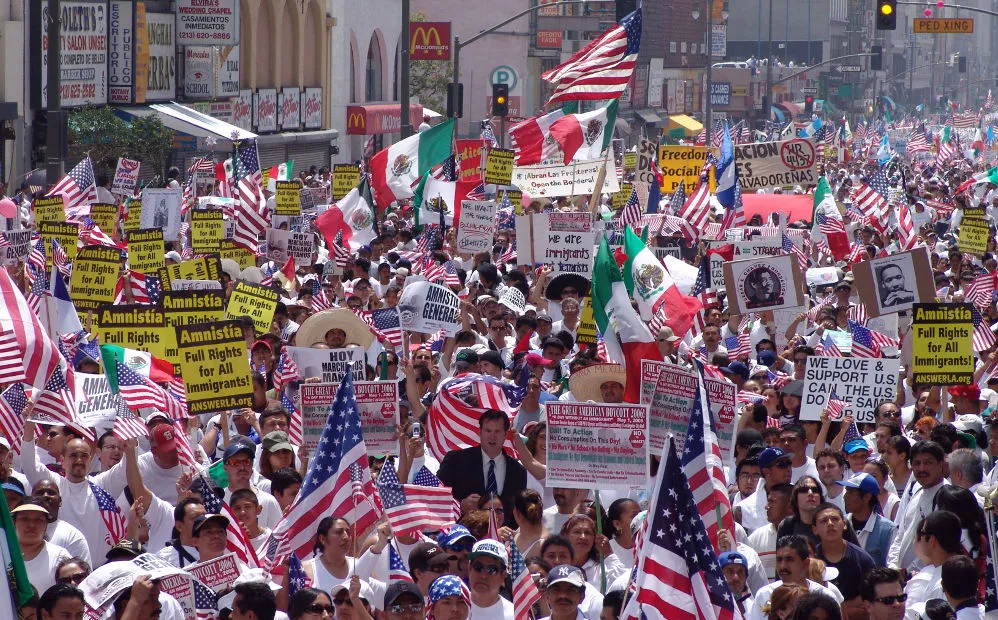
Immigrants have played a crucial role in movements for social justice in the United States. Migrants and their allies have led the fight for immigrant rights, but they have also played important roles in other movements, such as struggles for racial justice, reproductive rights, and labor organizing. While employers and policymakers often imagined immigrants as docile or passive, the historical record tells a different story—one of organizing, protest, and coalition-building. From well-known movements like those led by the United Farm Workers to lesser-known campaigns in factories, restaurants, and detention centers, immigrants have consistently challenged exploitation, racial discrimination, and exclusion. This section explores the diverse forms of activism—immigrant-led and coalition-based—that have shaped labor rights, immigration policy, and community life. These histories reveal how immigrants not only responded to injustice but also envisioned and built more equitable futures.
Scholarship
- Emma Amador, The Politics of Care Work Puerto Rican Women Organizing for Social Justice (2025)
- Xóchitl Bada and Shannon Gleeson, eds., Accountability across Borders: Migrant Rights in North America (2019)
- Eladio B. Bobadilla, Dangerous Migration Mexican Labor and the Fight for Immigrant Rights (2026)
- Aviva Chomsky, Undocumented: How Immigration Became Illegal (2014)
- Sarah R. Coleman, The Walls Within: The Politics of Immigration in Modern America (2021)
- Johanna Fernández, The Young Lords: A Radical History (2020)
- Angela S. García, Legal Passing: Navigating Undocumented Life and Local Immigration Law (2019)
- Jennifer Guglielmo, Living the Revolution: Italian Women’s Resistance and Radicalism in New York City, 1880–1945 (2010)
- Felipe Hinojosa, Maggie Elmore and Sergio M. González, eds., Faith and Power: Latino Religious Politics Since 1945 (2022)
- Jesse Hoffnung-Garskof, Racial Migrations: New York City and the Revolutionary Politics of the Spanish Caribbean, 1850-1902 (2019)
- Winston James, Holding Aloft the Banner of Ethiopia: Caribbean Radicalism in Early Twentieth-Century America (1999)
- Lina-María Murillo, Fighting for Control: Power, Reproductive Care, and Race in the US-Mexico Borderlands (2023)
- A. Naomi Paik, Jason Ruiz, and Rebecca M. Schreiber, “Sanctuary’s Radical Networks,” Radical History Review 135 (October 2019): 1-13.
- Amalia Pallares, Family Activism: Immigrant Struggles and the Politics of Noncitizenship (2014)
- Jimmy Patiño, Raza Sí, Migra No: Chicano Movement Struggles for Immigrant Rights in San Diego (2017)
- Jorge Ramírez-López, “‘Our Dark Hands and Sore Backs’: The Comité Cívico Popular Mixteco and the New Grassroots Activism by Indigenous Mexican Migrants,” Journal of American Ethnic History 43, no.2 (2024): 5–33
- Ellen D. Wu, The Color of Success: Asian Americans and the Origins of the Model Minority (2014)
- Chris Zepeda-Millán, Latino Mass Mobilization: Immigration, Racialization, and Activism (2017)
Resources
- A Class Apart PBS (documentary)
- Chicano! History of the Mexican-American Civil Rights Movement (documentary series)
- Lib Tietjen and Kira Garcia, A History of the Undocumented Immigrant, Tenement Museum, November 26, 2013 (public-facing article)
- Crossing Arizona (documentary)
- Documented: A film by an undocumented American (documentary)
- The Dream 9, Latino USA (podcast)
- Los Otros Dreamers, Latino USA (podcast)
- Jose Antonio Vargas, “My Life as an Undocumented Immigrant,” New York Times, June 26, 2011 (primary source document)
- The Right-Wing Latinos of Miami: Proud Boys and Refugees, VICE (documentary)
- How Democracy Works Now (documentary)
- Immigration Battle, PBS (documentary)
- Katie Worth, “What Makes Opponents of Immigration Reform So Effective?,” Frontline, October 20, 2015 (public-facing article)
- Las Abogadas: Attorneys on the Front Lines of the Migrant Crisis (documentary)
- Sanctuary: On the Border Between Church and State (podcast series)
- Chicano/Latino Movements History and Geography, Mapping American Social Movements Project (digital mapping project)
Week 13: Borders
United States expansion resulted in shifting and in many ways permeable national borders for generations. As the US increased its efforts to exclude and expel “undesirable” immigrants,border policing took on increased importance. From the creation of the Border Patrol in 1924 to “prevention through deterrence” in the early 1990s and into the 21st century, the US has expanded its efforts to regulate human mobility across national borders. In popular discourse, “the border” has long been shorthand for the Southwest, a product of an imaginary that linked Mexicanness with illegality and the region most linked to their presence as a place in need of policing. But in fact “the border” has historically encompassed all of the nation’s land and water boundaries, as well as other physical spaces that served as entry points into sovereign territory, such as airports. To maintain spatial control the US instituted uneven enforcement strategies at its myriad ports of entry and created legal regimes that codified border crossings as criminally transgressive. Border enforcement has created humanitarian catastrophes as landscapes have been weaponized as tools of exclusion. But borderlands are not solely spaces of state violence and control; they are also vibrant transnational spaces of community and culture.
Scholarship
- Ashley Johnson Bavery, Bootlegged Aliens: Immigration Politics on America’s Northern Border (2020)
- Brian D. Behnken, Borders of Violence & Justice: Mexicans, Mexican Americans, and Law Enforcement in the Southwest, 1835-1935 (2022)
- Geraldo L. Cadava, Standing on Common Ground: The Making of a Sunbelt Borderland (2013)
- Kornel Chang, Pacific Connections: The Making of the U.S.-Canadian Borderlands (2012)
- Jason De León, The Land of Open Graves: Living and Dying on the Migrant Trail (2015)
- Patrick W. Ettinger, Imaginary Lines: Border Enforcement and the Origins of Undocumented Immigration, 1882–1930 (2009)
- S. Deborah Kang, The INS on the Line: Making Immigration Law on the U.S.-Mexico Border, 1917–1954 (2017)
- Jeffrey S. Kahn, Islands of Sovereignty: Haitian Migration and the Borders of Empire (2019)
- Kelly Lytle Hernández, Migra!: A History of the U.S. Border Patrol (2010)
- Julian Lim, Porous Borders: Multiracial Migrations and the Law in the U.S.-Mexico Borderlands (2020)
- Monica Muñoz Martinez, The Injustice Never Leaves You: Anti-Mexican Violence in Texas (2018)
- Rachel St. John, Line in the Sand: A History of the Western U.S.-Mexico Border (2012)
Resources
- Oral History Interviews, Border Patrol Museum (primary source collection)
- Report of the Boundary Commission upon the Survey and Re-marking of the Boundary between the United States and Mexico West of the Rio Grande, 1891-96, University of North Texas Digital Library (primary source)
- United States-Mexico Border, Color Image Map Series, U.S. Geological Survey and U.S. Customs Service, 1979-1983, University of Texas, Austin Libraries (primary source collection)
- Borderland: Dispatches From The U.S.-Mexico Boundary, National Public Radio (podcast series)
- Javier Zamora, Solito 2023 (memoir/primary source)
- The Unafraid (documentary)
- The Infiltrators (documentary)
- Gloria Anzaldúa, Borderlands/La Frontera: The New Mestiza (analysis/primary source)
- Elisabeth Vallet, “The World is Witnessing a Rapid Proliferation of Border Walls,” Migration Policy Institute, March 2, 2022 (public-facing article)
- Luis Alberto Urrea, The Devil’s Highway: A True Story (public-facing book)
- “‘No Olvidado’: These Americans Find and Bury Missing Migrants,” CNN (documentary)
Week 14: Detention and Deportation
US efforts to exclude and expel undesirable immigrants resulted in the creation of massive systems of detention and deportation. Deportation has its roots in colonial-era practices of “warning out.” Precedents for deportation are also evident in antebellum schemes to remove emancipated slaves to a colony in Africa and the federal government’s forcible return of fugitives to their enslavers. Before the Civil War, state governments expelled “undesirable” foreigners, such as the Irish poor. Deportation expanded after the introduction of federal Chinese exclusion in the late 19th century, as US law concretized the sovereign right to expel unauthorized immigrants and concluded that such expulsion was an administrative matter rather than punishment for a crime. Immigrant detention began as an administrative matter as well: a temporary holding while deportations were processed or while an immigrant’s admissibility was determined. As with deportation, the inherently punitive nature of incarceration was minimized and obscured from the earliest days of this practice. Beginning in the 1980s, detention was radically expanded to deter migrants and asylum seekers, making immigrant incarceration a fundamental element of the US’s vast carceral system.
Scholarship
- Francisco E. Balderrama and Raymond Rodríguez, Decade of Betrayal: Mexican Repatriation in the 1930s, rev. ed. (2006)
- Ethan Blue, The Deportation Express: A History of America through Forced Removal (2021)
- Rachel Ida Buff, Against the Deportation Terror: Organizing for Immigrant Rights in the Twentieth Century (2017)
- Nicholas De Genova and Nathalie Peutz, eds., The Deportation Regime: Sovereignty, Space, and the Freedom of Movement (2010)
- Mark Dow, American Gulag: Inside U.S. Immigration Prisons (2004)
- Tanya Maria Golash-Boza, Deported: Immigrant Policing, Disposable Labor, and Global Capitalism (2015)
- Adam Goodman, The Deportation Machine: America’s Long History of Expelling Immigrants (2020)
- Torrie Hester, Deportation: The Origins of U.S. Policy (2017)
- Daniel Kanstroom, Aftermath: Deportation Law and the New American Diaspora (2012)
- Daniel Kanstroom, Deportation Nation: Outsiders in American History (2007)
- Carl Lindskoog, Detain and Punish: Haitian Refugees and the Rise of the World’s Largest Immigration Detention System (2018)
- Eithne Luibhéid and Karma R. Chávez, Queer and Trans Migrations: Dynamics of Illegalization, Detention, and Deportation (2020)
- Kelly Lytle Hernández, “The Crimes and Consequences of Illegal Immigration: A Cross-Border Examination of Operation Wetback, 1943-1954,” Western Historical Quarterly (Winter 2006), 421-444
- Brianna Nofil, The Migrant’s Jail: An American History of Mass Incarceration (2024)
- Jessica Ordaz, The Shadow of El Centro: A History of Migrant Incarceration and Solidarity (2021)
- Kristina Shull, Detention Empire: Reagan’s War on Immigrants and the Seeds of Resistance (2022)
- Elliott Young, Forever Prisoners: How the United States Made the World’s Largest Immigrant Detention System (2021)
Resources
- Transgression (documentary)
- The Bisbee Deportation of 1917, University of Arizona Library (online exhibition)
- Detention Mapping Project, Freedom for Immigrants (digital mapping project)
- TRAC Immigration Project, Transactional Records Access Clearinghouse (multimedia platform)
- Emma Goldman on the restriction of civil liberties, 1919, The Gilder Lehrman Institute of American History (primary source)
- Sentenced Home, PBS (documentary)
- Alex Wagner, “America’s Forgotten History of Illegal Deportations,” The Atlantic, March 6, 2017
- Doris Meissner, Donald M. Kerwin, Muzaffar Chishti and Claire Bergeron, “Immigration Enforcement in the United States: The Rise of a Formidable Machinery,” Migration Policy Institute (investigative report)
- Patrice Taddonio and Daffodil Altan, “With Renewed Attention to the Border, These 8 Documentaries Illuminate US Immigration Policies Involving Kids,” Frontline, March 31, 2021 (public-facing article)
- Immigration and the Carceral State (digital exhibit)
- Immigration Nation, Netflix (documentary series)
Week 15: The 21st Century
The United States experienced a resurgence of nativism at the turn of the 21st century. In the 1990s, states and the federal government passed laws restricting the rights and mobility of immigrants. The surveillance and criminalization of immigrants increased again after the attacks of September 11, 2001, when the United States reorganized its immigration bureaucracy as part of its “global war on terrorism,” efforts frequently marked by Islamophobia and racism. Stalled efforts to pass immigration reform legislation combined with ongoing global migrations related to climate change, war, and conflict made immigration an increasingly salient and politicized issue in the United States. While the 21st century has seen powerful immigrant rights organizing and daily reminders of the strength of immigrant communities, xenophobia and immigrant scapegoating pervade political discourse, and immigrant communities are under threat. (Due to the timing of this update, the proliferation of analysis and documents reflecting the second Trump administration could not be included here.)
Scholarship
- Moustafa Bayoumi, How Does It Feel to Be a Problem?: Being Young and Arab in America (2009)
- Elizabeth F. Cohen, Illegal: How America’s Lawless Immigration Regime Threatens Us All (2020)
- Daniel Denvir, All-American Nativism: How the Bipartisan War on Immigrants Explains Politics as We Know It (2020)
- Lori A. Flores, Awaiting Their Feast: Latinx Food Workers and Activism from World War II to COVID-19 (2025)
- María Cristina García, State of Disaster: The Failure of U.S. Migration Policy in an Age of Climate Change (2022)
- Phillip B. Gonzales, Renato Rosaldo, and Mary Louise Pratt, Trumpism, Mexican America, and the Struggle for Latinx Citizenship (2021)
- William D. Lopez, Separated: Family and Community in the Aftermath of an Immigration Raid (2019)
- Todd Miller, Empire of Borders: The Expansion of the U.S. Border around the World (2019)
- Nicole Nguyen, Suspect Communities: Anti-Muslim Racism and the Domestic War on Terror (2019)
- Juan F. Perea, Immigrants Out!: The New Nativism and the Anti-Immigrant Impulse in the United States (1997)
- Saher Selod, Forever Suspect: Racialized Surveillance of Muslim Americans in the War on Terror (2018)
- Tram Nguyen, We Are All Suspects Now: Untold Stories from Immigrant Communities after 9/11 (2005)
- Leti Volpp, “The Citizen and the Terrorist,” UCLA Law Review 49 (2002): 1575–1600
Resources
- Feisel Abdul Rauf, “Building on Faith,” New York Times, September 7, 2010
- Ted Hesson, “Five Ways Immigration System Changed after 9/11,” ABC News, September 13, 2012 (public-facing article)
- Statement of Senator Patrick Leahy, Chairman, Senate Judiciary Committee Subcommittee on Immigration “Effective Immigration Controls to Deter Terrorism”; October 17, 2001, Yale Law School (primary source)
- Statement of Dr. Demetrios G. Papademetriou Co-Director and Deborah Waller Meyers Policy Analyst Migration Policy Institute Before the Senate Judiciary Subcommittee on Immigration United States Senate Hearing on Border Security Issues and Options; October 17, 2001, Yale Law School (primary source)
- Fact Sheet: The Secure Fence Act of 2006, George W. Bush White House Archives (primary source)
- Mae Ngai, “How Grandma Got Legal” Los Angeles Times, May, 2006 and “Second-Class Citizens,” New York Times, January 30, 2014 (public-facing articles)
- Divided We Fall: Americans in the Aftermath (documentary)
- Immigration Battle, PBS (documentary)
- Out of Status, PBS (documentary)
- The State of Black Immigrants, Black Alliance for Just Immigration (report)
- Jessica Bolter, “Immigration Has Been a Defining, Often Contentious, Element Throughout U.S. History,” Migration Policy Institute, January 6, 2022 (public-facing article)
- Caitlin Dickerson, “The Secret History of Family Separation,” Atlantic, August 7, 2022 (public-facing article)
- Max Friedman,“Donald Trump’s Ban on Muslims Echoes Earliest Days of Nazi Propaganda,” Daily News, December 9, 2015
- Erika Lee, “A History Lesson for Donald Trump,” New York Daily News, August 18, 2015 (public-facing article)
- Cecilia Márquez, “Introduction to a Series on Latinxs and the Right,” Latinx Talk, August 6, 2025 (public-facing article)
- The Center for Migration Studies (contemporary research reports)
- Hispanics/Latinos, Pew Research Center (contemporary research reports)
- Documented (immigration news resource)
- Sahan Journal (immigration news resource)