Week 3: Nativism
The arrival of immigrants in growing numbers during the nineteenth century was met with a rising tide of nativism, as previous generations of settlers reimagined themselves as native to the United States and thereby entitled to distinct privileges. Hostility to immigrants was expressed in diverse forms, including anti-foreigner political movements, anti-Catholicism, private violence, and claims that particular groups of immigrants were forever “alien” and would never assimilate into American society. Nativist sentiments in this period triggered the introduction of state and federal laws to restrict the immigration of Black people, the poor, and Chinese laborers. These laws were driven by the ideas that undesirable, inferior foreigners were threatening Americans and that the United States had the right to protect itself from foreign threats. While nativism persists, this section focuses on nativist movements and laws introduced in the nineteenth century, which laid many of the ideological and legal foundations for modern U.S. immigration policy.
Scholarship
- Tyler Anbinder, Nativism and Slavery: The Northern Know Nothings and the Politics of the 1850s (1992)
- John Higham, Strangers in the Land: Patterns of American Nativism, 1860–1925 (2002)
- Hidetaka Hirota, Expelling the Poor: Atlantic Seaboard States and the Nineteenth-Century Origins of American Immigration Policy (2017)
- Erika Lee, America for Americans: A History of Xenophobia in the United States (2019)
- Beth Lew-Williams, The Chinese Must Go: Violence, Exclusion, and the Making of the Alien in America (2018)
- Luke J. Ritter, Inventing America’s First Immigration Crisis: Political Nativism in the Antebellum West (2021)
- Peter Schrag, Not Fit for Our Society: Nativism and Immigration (2010)
- Zachary M. Schrag, The Fires of Philadelphia: Citizen-Soldiers, Nativists, and the 1844 Riots over the Soul of a Nation (2021)
- Michael A. Schoeppner, “Black Migrants and Border Regulation in the Early United States,” Journal of the Civil War Era 11, no.3 (September 2021): 317-339
Resources
- Dillingham Commission, 1907-1911, U.S. Immigration Commission (primary source collection)
- Noel Hartman, “The Passing of the Great Race at 100,” Public Books, July 1, 2016 (public-facing article)
- Woodrow Wilson’s Veto Message on the 1915 Immigration Bill, The American Presidency Project (primary source)
- Asiatic Exclusion League, “Proceedings,” 1908, University of Minnesota Law Library (primary source)
- Randolph Bourne, “Trans-National America,” The Atlantic, 1916 (primary source)
- Chae Chan Ping v. United States (The Chinese Exclusion Case), 1889 (primary source)
- Chinese Exclusion Act, 1882, National Archives (primary source)
- Immigration through Angel Island, Digital Public Library of America (primary source set)
- Political Cartoons about the “Chinese Question,” Harper’s Weekly (primary source collection)
- Theodore Roosevelt, True Americanism, 1894, HathiTrust (primary source)
- United States v. Wong Kim Ark, 1897, Densho (primary source)
- Irene Hsu “The Echoes of Chinese Exclusion,” The New Republic, June 28, 2018(public-facing article)
- Hector Alejandro Arzate, “Chinese Immigrants Were Forced Out of Eureka in 1885 – Here’s How Locals Are Making That History Known,” KQED, October 15, 2021 (public-facing article)
- Irish Stereotype, Thomas Nast Cartoons (digital history)
Week 4: Mass Migration
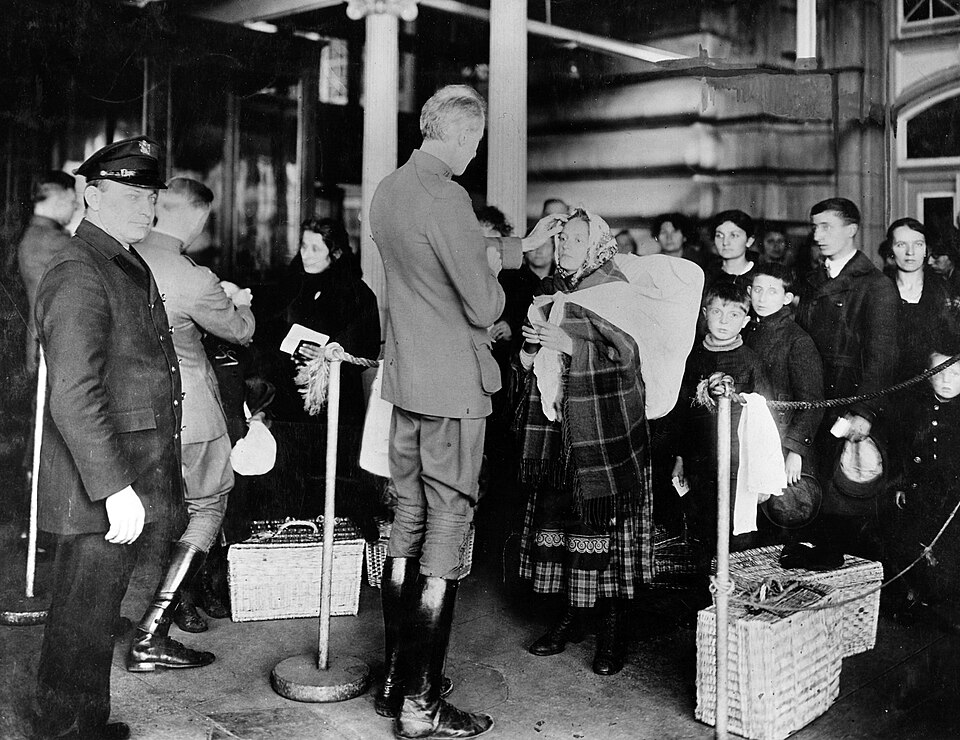
Beginning in the 1890s, an expanding and industrializing United States experienced a dramatic increase in immigration from throughout the world. Immigrants from southern and eastern Europe arrived in substantial numbers, including Italians and Eastern European Jews. Many of these immigrants passed through the newly opened immigration station at Ellis Island. Although the legal admission of Chinese laborers had been cut off by exclusion laws, Chinese migrants continued to enter the country. Immigrants from Japan, South Asia, and the newly acquired US territory of the Philippines arrived as well. Within the Americas, Mexican immigration increased during the Mexican Revolution of the 1910s. Caribbean migration was also significant, particularly migrants from the British West Indies who reconfigured the landscape of Black American politics and culture. In smaller numbers, immigrants from the Ottoman Empire arrived in the US, including Arab immigrants from Greater Syria, as did Cape Verdean immigrants from off the coast of Africa.
Scholarship
- Charlotte Karem Albrecht, Possible Histories: Arab Americans and the Queer Ecology of Peddling (2023)
- Edward E. Curtis, Muslims of the Heartland: How Syrian Immigrants Made a Home in the American Midwest (2022)
- Hasia R. Diner, Hungering for America: Italian, Irish, and Jewish Foodways in the Age of Migration (2001)
- Sonia C. Gomez, Picture Bride, War Bride: The Role of Marriage in Shaping Japanese America (2024)
- Marilyn Halter, Between Race and Ethnicity: Cape Verdean American Immigrants, 1860–1965 (1993)
- Madeline Y. Hsu, Dreaming of Gold, Dreaming of Home: Transnationalism and Migration between the United States and South China, 1882–1943 (2000)
- Matthew Frye Jacobson, Barbarian Virtues: The United States Encounters Foreign Peoples at Home and Abroad (2000)
- Violet Showers Johnson, The Other Black Bostonians: West Indians in Boston, 1900–1950 (2006)
- Kevin Kenny and Maddalena Marinari, eds., Rituals of Migration: Italians and Irish on the Move (2025)
- Adam M. McKeown, Melancholy Order: Asian Migration and the Globalization of Borders (2008)
- Adam D. Mendelsohn, The Rag Race: How Jews Sewed Their Way to Success in America and the British Empire (2014)
- Natalia Molina, Fit to Be Citizens? Public Health and Race in Los Angeles, 1879–1939 (2006)
- Daniel Morales, Between Here and There: Creating the Political Economy of Mexican Migration, 1900-1942 (2024)
- Lara Putnam, Radical Moves: Caribbean Migrants and the Politics of Race in the Jazz Age (2013)
- Dalen C. B. Wakeley-Smith, “‘The one primitive people who contact with civilization has failed to exterminate’: New York and ‘Gypsy’ Madness in the 1920s,” Journal of American Ethnic History 43, no. 1 (Fall 2023): 67–87
- Tara Zahra, The Great Departure: Mass Migration from Eastern Europe and the Making of the Free World (2017)
Scholarship
- Interviews and Other Primary Sources from the Ellis Island Collection, National Park Service (primary source collection)
- Forgotten Ellis Island (documentary)
- Carved in Silence (documentary)
- Island of Hope, Island of Tears (documentary)
- Great Migrations: A People on the Move, PBS (documentary series)
- Digitizing Immigrant Letters, Immigration History Research Center Archives (primary source collection)
- Mexican American Migrations and Communities, Library of Congress (primary source collection)
- The Great Migration, Digital Public Library of America (primary source set)
- Immigration and Americanization, 1880-1930, Digital Public Library of America (primary source set)
Week 5: Restriction
Growing xenophobia and entrenched ideas of immigrants’ racial inferiority led the federal government to pass a series of restrictive immigration laws in the late 19th and early 20th centuries. The Page Act of 1875, the Chinese Exclusion Act of 1882, and the general Immigration Act of 1882 marked the expansion of federal immigration control. By the early 20th century, US immigration law prohibited the admission of an array of foreigners: Chinese laborers, those with mental illnesses or contagious diseases, people likely to become public charges, those with criminal convictions, and other immigrants deemed “undesirable.” The Immigration Act of 1917 excluded immigrants from an “Asiatic barred zone” and required all immigrants to pass a literacy test. The growing legal architecture of exclusion culminated in the Immigration Act of 1924, also known as the Johnson-Reed Act, which created a national-origins quota system that dramatically reduced southern and eastern European immigration and virtually suspended all Asian immigration. Mexican immigrants (and others from independent nations in the Western Hemisphere) did not face numerical restrictions in the 1924 legislation, as lobbyists successfully argued that Mexican labor was essential to the agricultural industry, but the administrative systems developed to enforce immigration restriction significantly impacted migrants from Mexico and elsewhere in Latin America and the Caribbean.
Scholarship
- Danielle Battisti and S. Deborah Kang, eds., Hidden Histories of Unauthorized Migrations from Europe to the United States (2025)
- Ronald H. Bayor, Encountering Ellis Island: How European Immigrants Entered America (2014)
- Douglas C. Baynton, Defectives in the Land: Disability and Immigration in the Age of Eugenics (2016)
- Katherine Benton-Cohen, Inventing the Immigration Problem: The Dillingham Commission and Its Legacy (2018)
- Roger Daniels, Guarding the Golden Door: American Immigration Policy and Immigrants since 1882 (2005)
- Libby Garland, After They Closed the Gates: Jewish Illegal Immigration to the United States, 1921–1965 (2014)
- Thomas A. Guglielmo, White on Arrival: Italians, Race, Color, and Power in Chicago, 1890–1945 (2003)
- Matthew Frye Jacobson, Whiteness of a Different Color: European Immigrants and the Alchemy of Race (1998)
- Erika Lee, At America’s Gates: Chinese Immigration during the Exclusion Era, 1882–1943 (2003)
- Erika Lee and Judy Yung, Angel Island: Immigrant Gateway to America (2010)
- Beth Lew-Williams, John Doe Chinaman: A Forgotten History of Chinese Life under American Racial Law (2025)
- Julian Lim, “Mormons and Mohammedans: Race, Religion, and the Anti-Polygamy Bar in US Immigration Law,” Journal of American Ethnic History 41, no. 1 (Fall 2021): 5–49
- Eithne Luibhéid, Entry Denied: Controlling Sexuality at the Border (2002)
- Maddalena Marinari, Unwanted: Italian and Jewish Mobilization against Restrictive Immigration Laws, 1882–1965 (2020)
- Maddalena Marinari, Madeline Y. Hsu, and Maria Cristina García, eds., A Nation of Immigrants Reconsidered: US Society in an Age of Restriction, 1924–1965 (2019)
- Mae M. Ngai, “The Architecture of Race in American Immigration Law: A Reexamination of the Immigration Act of 1924,” Journal of American History 86, no. 1 (June 1999): 67–92
- Ivón Padilla-Rodríguez, “‘Los Hijos Son La Riqueza Del Pobre:’Mexican Child Migration and the Making of Domestic (Im)migrant Exclusion, 1937–1960,” Journal of American Ethnic History 42, no.1 (2022): 43–81
- Lucy E. Salyer, Laws Harsh as Tigers: Chinese Immigrants and the Shaping of Modern Immigration Law (1995)
- Aristide R. Zolberg, A Nation by Design: Immigration Policy in the Fashioning of America (2008)
Resources
- “An Un-American Bill:” A Congressman Denounces Immigration Quotas, History Matters (primary source)
- Immigration Quotas, 1925-1927, History Matters (primary source)
- “Shut the Door:” A Senator Speaks for Immigration Restriction, History Matters (primary source)
- “The Senate’s Declaration of War:” Japan Responds to Japanese Exclusion, History Matters (primary source)
- U.S. v. Bhagat Singh Thind (1923), History Matters (primary source)
- Repatriation and Deportation of Mexicans 1932-1936, Boulder County Latino History (primary source collection)
- 14: Dred Scott, Wong Kim Ark, and Vanessa Lopez (documentary)
- Dollar a Day, Ten Cents a Dance (documentary)
Week 6: Empire
Empire – the exercise of one nation’s power and influence in ways that shape hierarchies of belonging and exert control over the peoples, places, and resources of other nations – has long influenced the role of the United States in the wider world and the ways people have moved through it. The arrival of settlers from Europe played a pivotal role in continental expansion in the United States and the dispossession of Indigenous peoples that made it possible. Competition for natural resources between the United States and other global empires shaped labor migrations within and beyond American borders. The US acquisition of foreign territories moved the nation’s borders across people and moved people across borders. And the intervention of the United States in the affairs of other countries has led to mass displacement – raising difficult questions about the country’s obligation to welcome immigrants and refugees whose reasons for leaving their homes have been shaped by U.S. imperialism.
Scholarship
- Eiichiro Azuma, Between Two Empires: Race, History, and Transnationalism in Japanese America (2005)
- Rick Baldoz, The Third Asiatic Invasion: Empire and Migration in Filipino America, 1898–1946 (2011)
- Catherine Ceniza Choy, Empire of Care: Nursing and Migration in Filipino American History (2003)
- Kaysha Corinealdi, Panama in Black: Afro-Caribbean World Making in the Twentieth Century (2022)
- Donna R. Gabaccia, Foreign Relations: American Immigration in Global Perspective (2012)
- Ismael García-Colón, Colonial Migrants at the Heart of Empire: Puerto Rican Workers on U.S. Farms (2020)
- Juan González, Harvest of Empire: A History of Latinos in America (2022)
- Julie Greene, The Canal Builders: Making America’s Empire at the Panama Canal (2009)
- Frank Andre Guridy, Forging Diaspora: Afro-Cubans and African Americans in a World of Empire and Jim Crow (2010)
- Jesse Hoffnung-Garskof, A Tale of Two Cities: Santo Domingo and New York after 1950 (2008)
- Moon-Ho Jung, Menace to Empire: Anticolonial Solidarities and the Transpacific Origins of the U.S. Security State (2022)
- Paul A. Kramer, “The Geopolitics of Mobility: Immigration Policy and American Global Power in the Long Twentieth Century,” American Historical Review 123, no.2 (April 2018): 393–438
- Adrian De Leon, Bundok: A Hinterland History of Filipino America (2023)
- Adrian De Leon, “Frank Mancao’s ‘Pinoy Image’: Photography, Masculinity, and Respectability in Depression-Era California,” Journal of American Ethnic History 41, no. 2 (Winter 2022): 58–94
- Simeon Man, Soldiering through Empire: Race and the Making of the Decolonizing Pacific (2018)
- Alaina M. Morgan, Atlantic Crescent: Building Geographies of Black and Muslim Liberation in the African Diaspora (2025)
- María L. Quintana, Contracting Freedom: Race, Empire, and U.S. Guestworker Programs (2022)
- Vicki L. Ruiz, “Nuestra América: Latino History as United States History,” Journal of American History 93, no. 3 (December 2006): 655–672
- Seema Sohi, Echoes of Mutiny: Race, Surveillance, and Indian Anticolonialism in North America (2014)
- Chris Suh, The Allure of Empire: American Encounters with Asians in the Age of Transpacific Expansion and Exclusion (2023)
- Dorothy B. Fujita-Rony, American Workers, Colonial Power: Philippine Seattle and the Transpacific West, 1919–1941 (2003)
- Harsha Walia, Border & Rule: Global Migration, Capitalism, and the Rise of Racist Nationalism (2021)
Resources
- Documenting the Southeast Asian American Experience, UC Irvine (primary source collection)
- The Spanish-American War: The United States Becomes a World Power, Library of Congress (primary source set)
- Pietri, Puerto Rican Obituary, Poetry Foundation (primary source)
- Puerto Rican Migration to the US, Digital Public Library of America (primary source set)
- American Empire, Digital Public Library of America (digital exhibit)
- “The History of American Imperialism, From Bloody Conquest to Bird Poop,” Fresh Air, February 18, 2019 (public-facing talk)
- Savage Acts: Wars, Fairs, and Empire 1898-1904 (documentary)
- Primary Documents and the History of American Foreign Relations, Society for Historians of American Foreign Relations (primary source collection)
- “Harvest of Empire: Juan González on His Landmark Book, Immigration & Consequences of U.S. Imperialism,” Democracy Now!, June 13, 2022 (public-facing talk)
- Harvest of Empire: The Untold Story of Latinos in America (documentary)
- Guantánamo Public Memory Project (digital history project)
- Asian Americans & Pacific Islanders: A Philadelphia Story, PBS, (documentary series)
- Louis Dalrymple, School Begins, 1899, Library of Congress (primary source)