Week 9: Global Migration
After World War II, new pressures related to global decolonization and U.S. foreign affairs during the Cold War helped transform immigration policies. No less important, domestic civil rights activism pushed the nation to reject racially discriminatory restrictions on immigration, including Asian exclusion. In this context, the 1965 Immigration Act helped increase immigration, over the next decades, of people from Latin America, Asia, Africa, as well as Europe. However, the Act also introduced the first numerical limitations on Latin American migration, denying millions of immigrants a legal pathway. While immigration to the United States had always been global in scope, post-1965 immigration brought diversity on a new scale. As the United States became a global superpower, its economy and culture were strengthened by immigrant workers, consumers, and family members. The civil rights movement’s triumphs ensured that newcomers and their children arrived in a United States that was formally committed to equality; in reality, immigrants would continue to fight for recognition of their rights and dignity.
Scholarship
- Leisy J. Abrego, Sacrificing Families: Navigating Laws, Labor, and Love across Borders (2014)
- Yvette M. Alex-Assensoh, “African Immigrants and African-Americans: An Analysis of Voluntary African Immigration and the Evolution of Black Ethnic Politics in America,” African and Asian Studies 8 no.1-2, (March 2009): 89-124
- Danielle Battisti, Whom We Shall Welcome: Italian Americans and Immigration Reform, 1945–1965 (2019)
- Gabriel J. Chin and Rose Cuison Villazor, The Immigration and Nationality Act of 1965: Legislating a New America (2015)
- Nancy Foner, From Ellis Island to JFK: New York’s Two Great Waves of Immigration (2000)
- María Cristina García and Maddalena Marinari, eds., Whose America? U.S. Immigration Policy since 1980 (2023)
- Carly Goodman, Dreamland: America’s Immigration Lottery in an Age of Restriction (2023)
- Marilyn Halter and Violet Showers Johnson, African & American: West Africans in Post–Civil Rights America (2014)
- Jane H. Hong, Opening the Gates to Asia: A Transpacific History of How America Repealed Asian Exclusion (2019)
- Madeline Y. Hsu, The Good Immigrants: How the Yellow Peril Became the Model Minority (2015)
- Roberto Lovato, Unforgetting: A Memoir of Family, Migration, Gangs, and Revolution in the Americas (2020)
- Cecilia Márquez, Making the Latino South: A History of Racial Formation (2023)
- Maddalena Marinari, “‘Americans Must Show Justice in Immigration Policies Too’: The Passage of the 1965 Immigration Act,” Journal of Policy History 26, no.2 (April 2014): 219-245
- Douglas S. Massey and Karen A. Pren, “Unintended Consequences of U.S. Immigration Policy: Explaining the Post-1965 Surge from Latin America,” Population and Development Review 38, no. 1 (March 2012): 1–29.
- Ana Raquel Minian, Undocumented Lives: The Untold Story of Mexican Migration (2018)
- Arissa H. Oh, To Save the Children of Korea: The Cold War Origins of International Adoption (2015)
- Alejandro Portes and Rubén G. Rumbaut, Immigrant America: A Portrait, 4th ed. (2014)
- Uzma Quraishi, Redefining the Immigrant South: Indian and Pakistani Immigration to Houston during the Cold War (2020)
- Erik R. Scott, Defectors: How the Illicit Flight of Soviet Citizens Built the Borders of the Cold War World (2023)
- Mary C. Waters, Reed Ueda, and Helen B. Marrow, eds., The New Americans: A Guide to Immigration since 1965 (2007)
Resources
- First Days Project, South Asian American Digital Archive (oral history collection)
- The 1965 Immigration and Nationality Act, DocsTeach (primary source)
- Lyndon Baines Johnson, Special Message to the Congress on Immigration, January 13, 1965 (primary source)
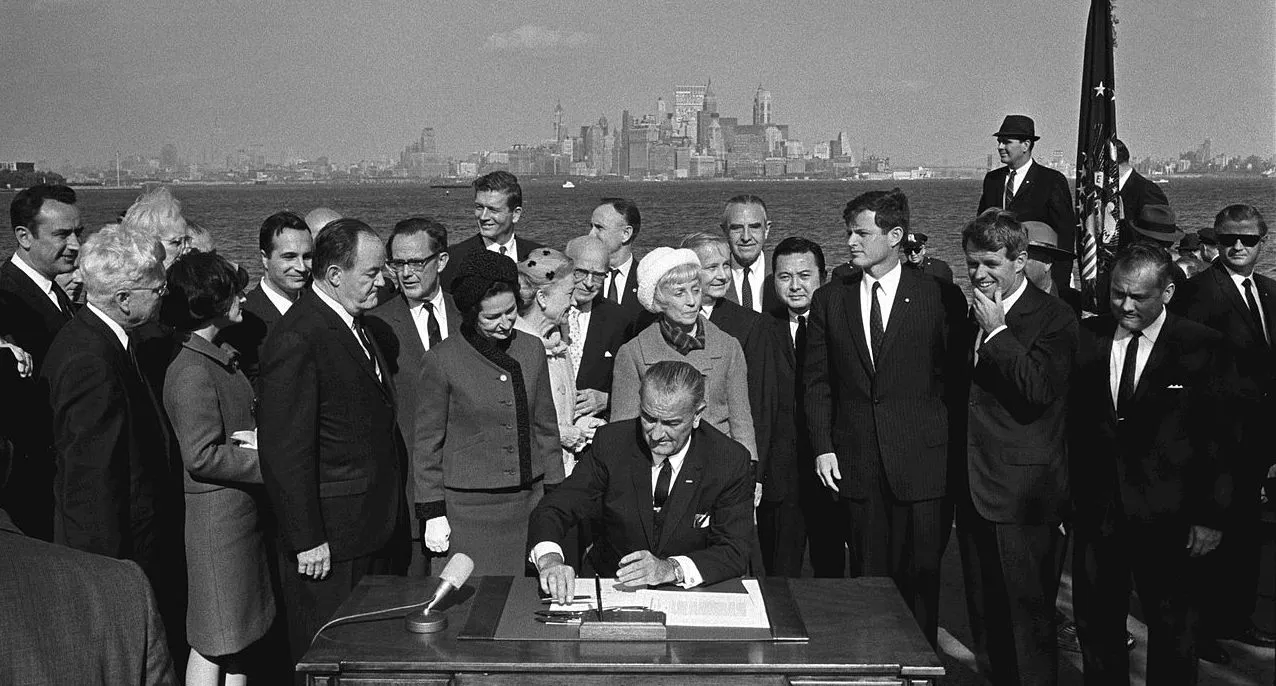
- Lyndon Baines Johnson, Remarks at the Signing of the Immigration Bill, Liberty Island, New York, The American Presidency Project (primary source collection)
- Ronald Reagan, Remarks on Signing the Immigration Reform and Control Act of 1986, Ronald Reagan President Library & Museum (primary source)
- Muzaffar Chishti, Faye Hipsman, and Isabel Ball, “Fifty Years On, the 1965 Immigration and Nationality Act Continues to Reshape the United States,” Migration Policy Institute, October 15, 2015 (public-facing article)
- Latino Americans, PBS (documentary series)
- Immigrant Stories, Immigration History Research Center (primary source collection)
- A Pastoral Letter Concerning Migration from the Catholic Bishops of Mexico and the United States, 2003 (primary source document)
- The Archive of Immigrant Voices, The Center for Global Migration Studies at the University of Maryland, College Park (interview collection)
- Minnesota Immigrant Oral Histories, Minnesota Historical Society (oral history collection)
- South Asian Oral History Project, University of Washington Library (oral history collection)
Week 10: Refuge
Thomas Paine’s aspirational invocation of the United States as an “asylum for mankind” in his 1776 political pamphlet Common Sense placed refuge, asylum, and sanctuary at the very center of the country’s rise as an independent nation. But the ways Americans have heeded the call to make the United States a place of refuge that embraces a spirit of unconditional welcome have varied greatly. While religious and political refugees have migrated to the United States since its earliest days, their initial arrivals were to a country with a government that actively displaced and dispossessed Indigenous peoples and where it was legal for white Americans to own as human property people of African descent who were forced from their homes into lives of servitude and unfreedom. Since then, the nation’s own domestic and foreign interests have played as much of a role in determining which refugees and asylum seekers are welcomed across the nation’s borders as the interests and needs of refugees and asylum seekers themselves. Upon arrival, meanwhile, refugees in the United States have both been embraced and met with skepticism, prejudice, and even violence from their new neighbors and countrypeople. The story of American refuge is a story of welcoming, excluding, and even creating refugees.
Scholarship
- Melissa May Borja, Follow the New Way: American Refugee Resettlement Policy and Hmong Religious Change (2023)
- Carl J. Bon Tempo, Americans at the Gate: The United States and Refugees during the Cold War (2008)
- Julio Capó Jr, “Queering Mariel: Mediating Cold War Foreign Policy and U.S. Citizenship among Cuba’s Homosexual Exile Community, 1978-1994,” Journal of American Ethnic History 29, no. 4 (Summer 2010): 78-106
- Yến Lê Espiritu, Body Counts: The Vietnam War and Militarized Refuge(es) (2014)
- Yến Lê Espiritu et al., Departures An Introduction to Critical Refugee Studies (2022)
- David FitzGerald, Refuge Beyond Reach: How Rich Democracies Repel Asylum Seekers (2019)
- María Cristina García, Havana USA: Cuban Exiles and Cuban Americans in South Florida, 1959–1994 (1996)
- María Cristina García, The Refugee Challenge in Post–Cold War America (2017)
- Paul A. Kramer, “Unsettled Subjects: Inventing the Refugee in North American History,” Journal of American Ethnic History 39, no.3 (Spring 2020): 5-16
- Jana K. Lipman, In Camps: Vietnamese Refugees, Asylum Seekers, and Repatriates (2020)
- Laura Madokoro, Elusive Refuge: Chinese Migrants in the Cold War (2017)
- Yael Schacher, “Return of the Repressed: Asylum in the 1920s and Today,” Journal of American History 109, no.2 (September 2022): 375–387
- Eric Tang, Unsettled: Cambodian Refugees in the New York City Hyperghetto (2015)
- Cecilia M. Tsu, “‘If You Want to Plow Your Field, Don’t Kill Your Buffalo to Eat’: Hmong Farm Cooperatives and Refugee Resettlement in 1980s Minnesota,” Journal of American Ethnic History 36, no. 3 (Spring 2017): 38–73
- Domenic Vitiello, The Sanctuary City: Immigrant, Refugee, and Receiving Communities in Postindustrial Philadelphia (2022)
Resources
- Text of the 1951 Convention Relating to the Status of Refugees and Text of the 1967 Protocol Relating to the Status of Refugees, United Nations (primary source)
- The 1980 Refugee Act, National Archives Foundation (primary source)
- Sarah Corbett, “The Lost Boys of Sudan: The Long, Long, Long Road to Fargo,” New York Times Magazine, April 1, 2001 (public-facing article)
- First They Killed My Father: A Daughter of Cambodia Remembers (documentary)
- Lost Boys of Sudan, PBS (documentary series)
- The Betrayal: Nerakhoon (documentary)
- Crossing Over: Stories of Immigration and Identity (documentary)
- Evan Taparata and Rachel Ida Buff, “Refuge: Denied. Asylum: Pending,” Public Books July 8, 2021 (public-facing article)
- “The Out Crowd,” This American Life, May 15, 2020 (podcast)
- The Other Side of the Water:Immigration and the Promise of Racial Justice, NYU School of Law (podcast series)
- Well Founded Fear, PBS (documentary)
- Refugee History (digital exhibit)
- Cuban Immigration After the Revolution, Digital Public Library of America (primary source set)
- Digital Stories, Green Card Voices (oral history collection)
- Viet Stories: Vietnamese American Oral History project, Calisphere, University of California (oral history project)
Week 11: Community
Immigration is a fundamentally communal process, and in all eras immigrants have created places where they could feel at home in a new country. This process was often profoundly political, with communities serving as spaces of safety, pride, and advocacy. Immigrants built identifiable neighborhoods with everyday destinations like restaurants, food markets, clubs, and other businesses; they also established houses of worship, mutual aid societies, newspapers, schools, theaters, and cultural centers. Initially, places like these made it possible for newcomers to gather, locate compatriots, speak their languages, and find their footing in a new land while maintaining their cultural identities; later, these became sites of ethnicization where they could teach subsequent generations how to maintain cultural practices and identity. Communities often transcended locality; they have often been transnational, with migrants regularly traveling and fostering ties between their original and adoptive homes in ways that linked their worlds together.
Scholarship
- Vivek Bald, Bengali Harlem and the Lost Histories of South Asian America (2013)
- Llana Barber, Latino City: Immigration and Urban Crisis in Lawrence, Massachusetts, 1945–2000 (2017)
- Julio Capó, Welcome to Fairyland: Queer Miami before 1940 (2017)
- Mike Amezcua, Making Mexican Chicago: From Postwar Settlement to the Age of Gentrification (2023)
- Lilia Fernández, Brown in the Windy City: Mexicans and Puerto Ricans in Postwar Chicago (2012)
- Sergio M. González, Strangers No Longer: Latino Belonging and Faith in Twentieth-Century Wisconsin (2024)
- Adam McKeown, Chinese Migrant Networks and Cultural Change: Peru, Chicago, Hawaii, 1900–1936 (2001)
- Natalia Molina, A Place at the Nayarit: How a Mexican Restaurant Nourished a Community (2022)
- Robert A. Orsi, The Madonna of 115th Street: Faith and Community in Italian Harlem, 1880–1950, 3rd ed. (2010)
- George J. Sánchez, Becoming Mexican American: Ethnicity, Culture, and Identity in Chicano Los Angeles, 1900–1945 (1993)
- A. K. Sandoval-Strausz, Barrio America: How Latino Immigrants Saved the American City (2019)
- James Zarsadiaz, Resisting Change in Suburbia: Asian Immigrants and Frontier Nostalgia in L.A. (2022)
- Xiaojian Zhao, Remaking Chinese America: Immigration, Family, and Community, 1940–1965 (2002)
Resources
- Global Boston: A Portal to the Region’s Immigrant Past and Present, Boston College (digital history project)
- Collections and Connections, Japanese American History Archives-Seizo Oka Collection (JAHA) (digital history collection)
- South Asian American Digital Archive (digital history and archives)
- Your Story, Our Story, Tenement Museum (digital storytelling project)